
From Panic to Precision: How Real-Time Data Innovates Evacuations
by EvacTracker Founder, Dr. Rashid Khan
Emergencies are inherently dynamic. Conditions shift rapidly, risks evolve, and information can become outdated within moments. Despite this, many evacuation processes still rely on static plans, fixed signage, and linear communication chains that were never designed to respond to real-time change. This disconnect between planning and reality is where inefficiencies and ultimately risk begin to emerge.
Globally, research continues to highlight that communication breakdowns and limited situational awareness are among the leading causes of delayed evacuations and avoidable harm. In high-pressure environments, occupants are often left to interpret incomplete information, while response teams operate without full visibility. The result is hesitation, congestion, and decision-making driven more by instinct than by accurate guidance.
Real-time data fundamentally changes this equation. By enabling systems to respond to conditions as they are, rather than as they were, evacuations become adaptive rather than reactive. This shift is critical in environments where seconds matter, and assumptions can no longer be relied upon.
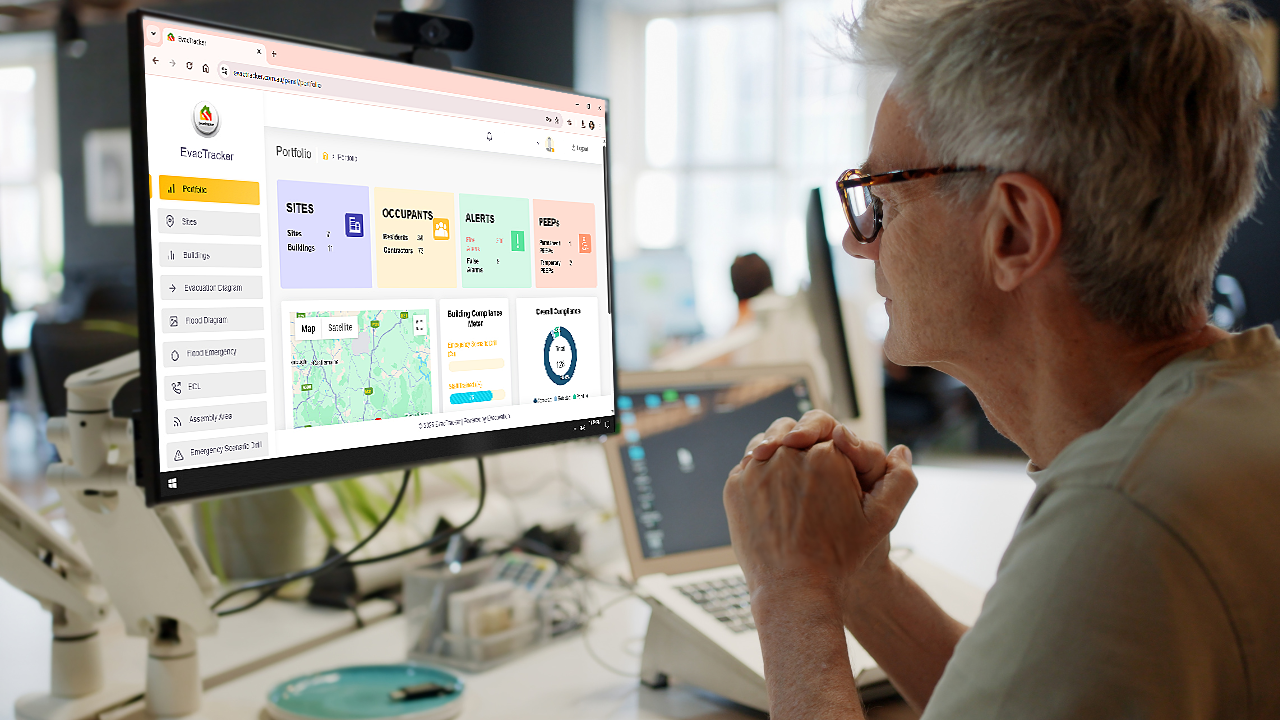
EvacTracker was developed with this principle at its core. The platform integrates live data to continuously update evacuation pathways, assembly points, and communication flows. If conditions change, whether an exit becomes inaccessible or a new hazard emerges, guidance is immediately recalibrated and delivered to both occupants and coordinators. This ensures that every decision made during an evacuation is informed by current, not outdated, information.
For emergency teams and building managers, this creates a level of operational visibility that has traditionally been difficult to achieve. Real-time dashboards provide clarity on who has evacuated, who may still be inside, and where assistance may be required. This removes one of the most critical uncertainties in emergency response: the absence of reliable, real-time insight.
For occupants, the impact is equally significant. Clear, location-specific instructions reduce reliance on crowd behaviour and eliminate the need for guesswork. Individuals are able to act with confidence, following guidance that reflects their immediate environment rather than a generic plan.
The efficiency gains are measurable. Traditional evacuation communication processes can take upwards of 20 minutes to reach all relevant parties. Real-time platforms significantly compress this timeframe, ensuring that accurate information is distributed rapidly and consistently. In emergency scenarios, this reduction in delay directly correlates to reduced exposure to risk.
EvacTracker represents a broader shift in how evacuation planning is approached, from static compliance to responsive systems. In an environment where unpredictability is the only constant, precision is no longer an advantage; it is essential to achieving safer outcomes.