

You’re on Floor 20. The Alarm Just Went Off. Do You Know How Long It Takes to Get Out?
By Dr. Rashid Khan, Founder of EvacTracker
It is 2:30 in the morning. You are asleep on level 20 of a residential apartment building in Melbourne. The fire alarm goes off.
What do you do next?
If you are like most Australian apartment residents, the honest answer is: you are not entirely sure. You know, broadly, that you should leave. You know there are fire stairs somewhere. You may have a vague memory of a notice in the lift lobby, or a letter that arrived when you first moved in, that you put in a drawer and never read.
That uncertainty, that gap between knowing an alarm is sounding and knowing exactly what to do, is not your fault. It is a systemic failure. And in a country with one of the fastest-growing high-rise residential populations in the world, it is a failure we can no longer afford to ignore.
Let’s Do the Maths
Consider a standard 20-storey residential apartment building, the kind being built across Melbourne, Sydney, and Brisbane at a rate that has reshaped the skylines of our major cities. Ten apartments per floor. Two hundred apartments in total.
Based on the Australian Bureau of Statistics’ average household size of approximately 2.5 persons, the building houses around 500 residents. In a real-world emergency evacuation, all of them or most of them will be moving toward the same stairwells simultaneously.
Research on stairwell evacuation speeds in residential buildings provides a sobering baseline. Under calm, practised conditions, occupants typically descend at a rate of approximately one floor every 30 to 45 seconds. That gives a resident on level 20 a stairwell travel time of 10 to 15 minutes under ideal conditions, before accounting for congestion.
But evacuations are rarely calm. In a real alarm event, particularly at night, people are disoriented, partially dressed, and uncertain about whether the alarm is real. Some will wait to see if it stops. Some will try to use the lift, which is exactly what they must not do. Some will have mobility limitations that slow not just themselves but everyone behind them in a narrow stairwell. And some will not have heard the alarm at all.
When you model a full building evacuation with realistic behaviour patterns: hesitation, congestion, counter-flows, and the physical bottleneck of two fire stairs serving 500 people, total evacuation times of 25 to 40 minutes are not unusual for a 20-storey building. In some scenarios, significantly longer.
“In a fire, the first ten minutes determine outcomes. The next thirty are consequences.”
The Lacrosse Building: A Melbourne Wake-Up Call
In November 2014, a fire broke out on the eighth-floor balcony of the Lacrosse apartment building in Melbourne’s Docklands. It was 2:47 in the morning. Within 11 minutes, the fire had spread from level 8 to level 21 – a rate of spread that shocked investigators and led to years of legal proceedings about the building’s non-compliant aluminium composite cladding.
The building was evacuated, and no lives were lost, a fact attributable as much to the efforts of individual residents and attending firefighters as to any pre-planned evacuation process. But the aftermath revealed something deeply uncomfortable: that tens of thousands of Australians were living in buildings clad in materials that had no place in high-rise construction, and that most of them had no real knowledge of what to do if the worst happened.
The cladding issue has since prompted significant regulatory response across Australian states. But the communication and preparedness gap – the gap between having an evacuation plan and having one that residents have actually read, understood, and are ready to execute at 3 am – remains largely unaddressed.
Why Most Residential Evacuation Plans Don’t Work in Practice
I have spent years working with buildings, building managers, and emergency management professionals across Australia. And one of the most consistent findings is this: residential evacuation plans are written for compliance, not for clarity.
They are documents. Often good documents. Sometimes, detailed, well-considered documents. But they are produced to satisfy a regulatory requirement, filed in a binder or a building management system, and rarely, if ever, placed in the hands of the people they are designed to protect the residents themselves.
The result is a structural mismatch. Building managers may know exactly what the plan says. The residents on level 20, who are the ones who need to act on it at 2:30 in the morning, almost certainly do not.
This is compounded by turnover. In high-density residential buildings, particularly in inner Melbourne and Sydney, tenancy turnover is high. New residents arrive, receive a lease agreement and a set of keys, and may or may not receive any information about emergency procedures. In buildings with strata management, the chain of responsibility for communicating safety information can be genuinely unclear.
What a Real Solution Looks Like
When I built EvacTracker, I thought a great deal about this problem. Not the problem of compliance, that is relatively straightforward to solve, but the problem of reaching the person on level 20 at 2:30 in the morning with clear, actionable, location-specific guidance.
The traditional approach to evacuation communication relies on alarm tones, static signage, and the assumption that people will do the right thing if they hear a loud enough noise. But research on human behaviour in emergencies consistently shows that people need more than an alarm. They need to understand the nature of the threat, what action to take, and where to go. In the absence of that information, they wait. They look to others. They make decisions that may not be the right ones.
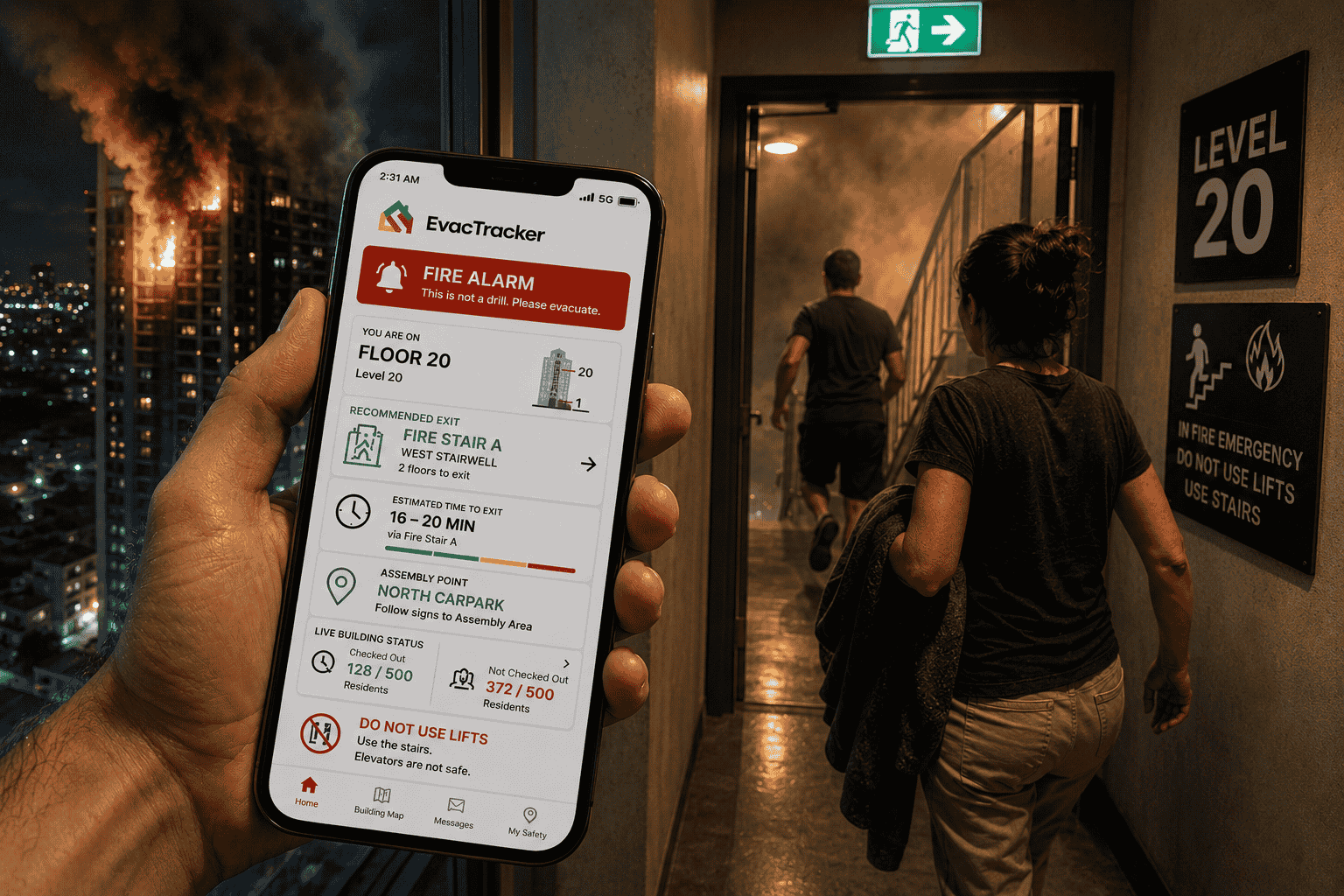
EvacTracker changes this by delivering real-time, personalised guidance directly to residents’ devices, telling them not just that an alarm has sounded, but which exit to use, what conditions look like, and where their assembly point is. It reduces the 20 to 25-minute communication lag that characterises traditional emergency notification down to approximately 9 minutes, through simultaneous multi-channel delivery that reaches everyone in the building at the same moment.
For building managers, it provides live visibility: who has left the building, who has not checked in, and where assistance may be required. For residents, it provides something that no static plan or alarm tone can provide: confidence. The confidence to act quickly, correctly, and without hesitation.
Because the question is not whether a high-rise alarm will sound in your building one day. It almost certainly will. The question is whether, when it does, every resident on every floor knows exactly what to do next.
That is not a question any Australian building should be leaving to chance